Contents
In the world of watchmaking, two camps faced each other for a long time: on one side the organic charm of mechanical automatic calibres, driven by the movement of the wrist; on the other the implacable rigour and surgical accuracy of quartz. In the late 1980s, the Japanese manufacture Seiko decided to refuse that trade-off. The goal? To create a timepiece with the poetry of a mechanical rotor and the precision of an electronic heart. That quest gave rise to one of the great technological revolutions of modern watchmaking: the Seiko Kinetic movement.
The beginning: the ambition of endless autonomy
It all starts at the Basel fair in 1986. Seiko unveils a revolutionary prototype under the trial name AGM. The idea is simple, and extremely difficult to industrialise: use the wearer’s natural movements to generate electricity and power a quartz calibre.
In 1988 the first commercially available watch appears under the name AGS (Automatic Generating System), before the Kinetic name was adopted in the early 1990s for the world market. Seiko had pulled off the audacious feat of removing the disposable battery from a quartz watch while keeping accuracy of the order of 15 seconds a month.
How does the Kinetic magic work?
To follow the journey of energy inside a Kinetic case, you have to look closely at its components:
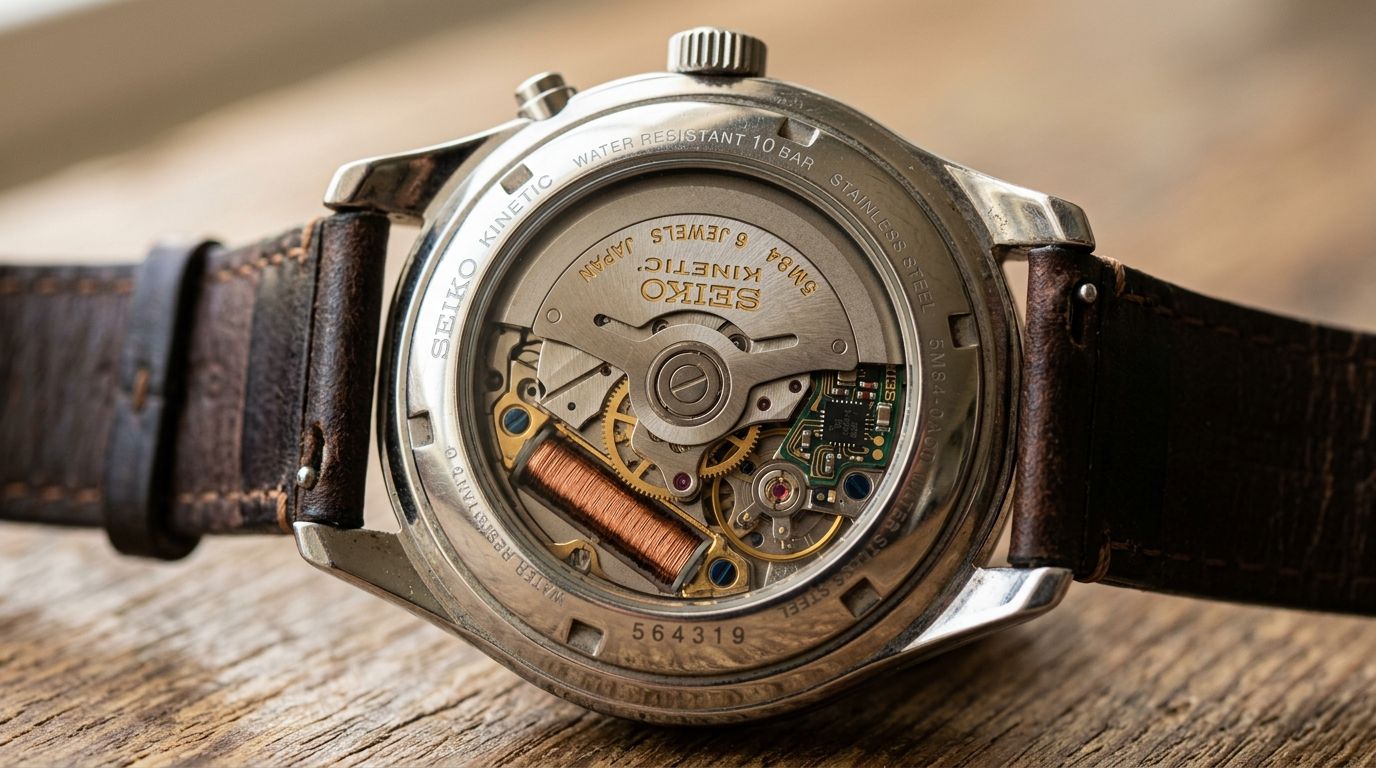
- The rotor (oscillating weight): with every movement of your arm, this weight pivots freely, exactly as in a traditional automatic watch.
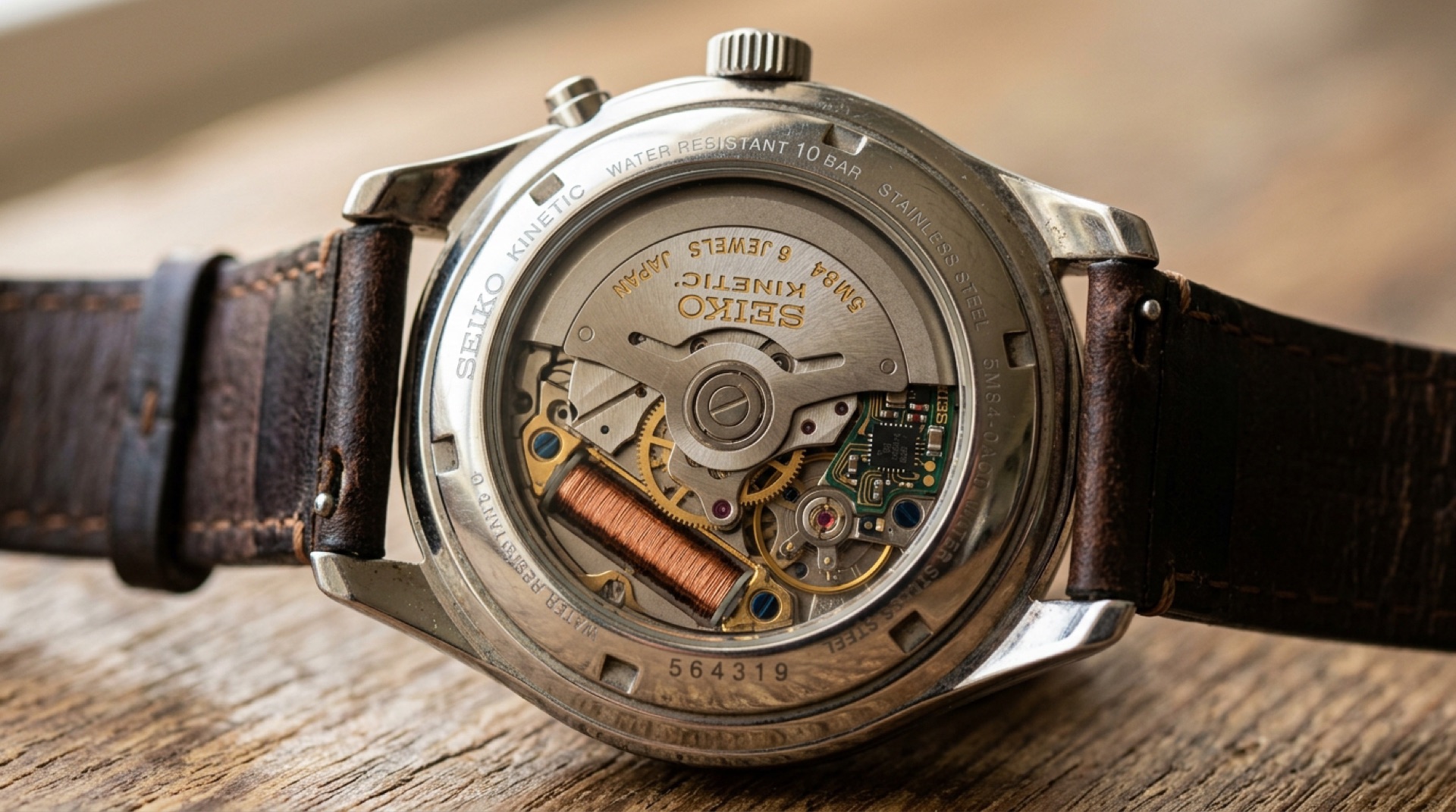
- The speed multiplier: this is where Japanese engineering excels. The rotor’s slow movement is stepped up through a gear train to spin a tiny generator rotor at up to an astonishing 100,000 revolutions per minute.
- The micro-generator: this minute spinning magnet induces an electric current in an ultra-fine copper coil.
- The capacitor (or lithium-ion cell): the current is sent to an accumulator that stores the energy. Unlike an ordinary battery, this accumulator is designed to be recharged thousands of times.
- The quartz regulator: the stored energy then powers the electronic circuit and the stepping motor that drives the hands with the legendary accuracy of quartz.
“The Kinetic movement is a bridge between two eras: it has the mechanical complexity enthusiasts love, and the uncompromising reliability the modern world demands.”
Legendary calibres and how they evolved
Over the decades Seiko refined the technology into ever more intelligent calibres, much sought after by collectors today:
The Auto Relay calibre (5J series)
Introduced in 1998, this movement solves the problem of discharge when the watch is not worn. If the watch sits still for about three days (72 hours), it slips into its power-save mode. The hands stop to save energy, but the internal IC quietly keeps counting time for up to four years. Pick the watch up and shake it, and the hands spring back into motion, spectacularly resetting themselves to the correct time. Magic.
The Direct Drive calibre (5D series)
Introduced in 2007, this high-end calibre offers a novel kind of interaction: as well as charging on the wrist, it can be wound by hand via the crown. The dial carries a real-time energy-reserve gauge that comes alive as you turn the crown, showing how much electricity each turn is generating.
The 5M series (the historic standard)
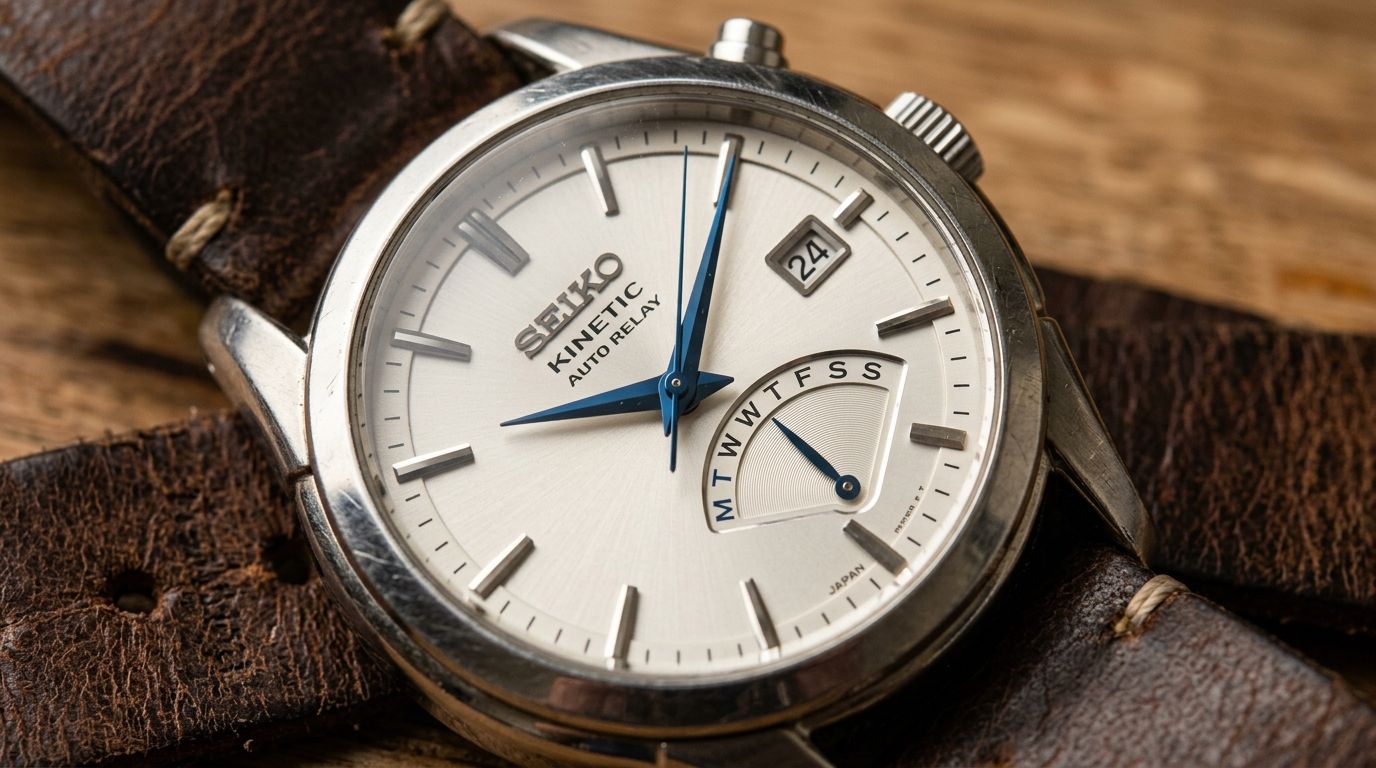
The 5M84 calibre is a perfect example of toughness paired with an elegant complication. As well as a six-month power reserve, it offers a push-button power-reserve indicator at 2 o’clock and a retrograde day indicator at 6 o’clock.
Why collect a Seiko Kinetic today?
Choosing a Kinetic means wearing a piece of watchmaking history. It means celebrating the pragmatism of a green, durable technology while still enjoying the mechanical ritual of the oscillating weight. In the wabi-sabi spirit, the patina of time here meets the endless return of energy: as long as you move, time moves on.
Whether it is a rare 1990s JDM model or a contemporary dress version, the Kinetic remains essential for anyone who loves genuine Japanese watches.
Receive our watchmaking stories
Calibre guides, new arrivals and stories from Japan — plus 10% off your first watch.