Contents
If Seiko is respected the world over today, it is because its watches were forged against the most extreme conditions on Earth and beyond it. From the sub-zero temperatures of the South Pole to the weightlessness of space, here is the story of two historic models that proved the absolute reliability of Japanese engineering.
The Seiko 62MAS (1965): the pioneer of the polar cold
In 1965, Seiko introduced the 6217-8000, better known today as the 62MAS (autoMAtic Self-dater). It was the brand’s very first diver’s watch, water-resistant to 150 metres.
To test the toughness of this pioneer, Seiko took a bold decision: to issue it — in its large-crown 6217-8001 version, easier to handle with gloves — to the members of the 8th Japanese Antarctic Research Expedition (JARE) in 1966. Subjected to constant freezing temperatures, to frozen seawater and to the daily knocks of polar exploration, the 62MAS ran without a single fault. That success confirmed Seiko’s technical excellence and laid the aesthetic foundations of every dive watch the brand would go on to make: substantial hands, highly luminous markers and a bidirectional rotating bezel.
The Seiko Pogue (6139): the first automatic chronograph in space
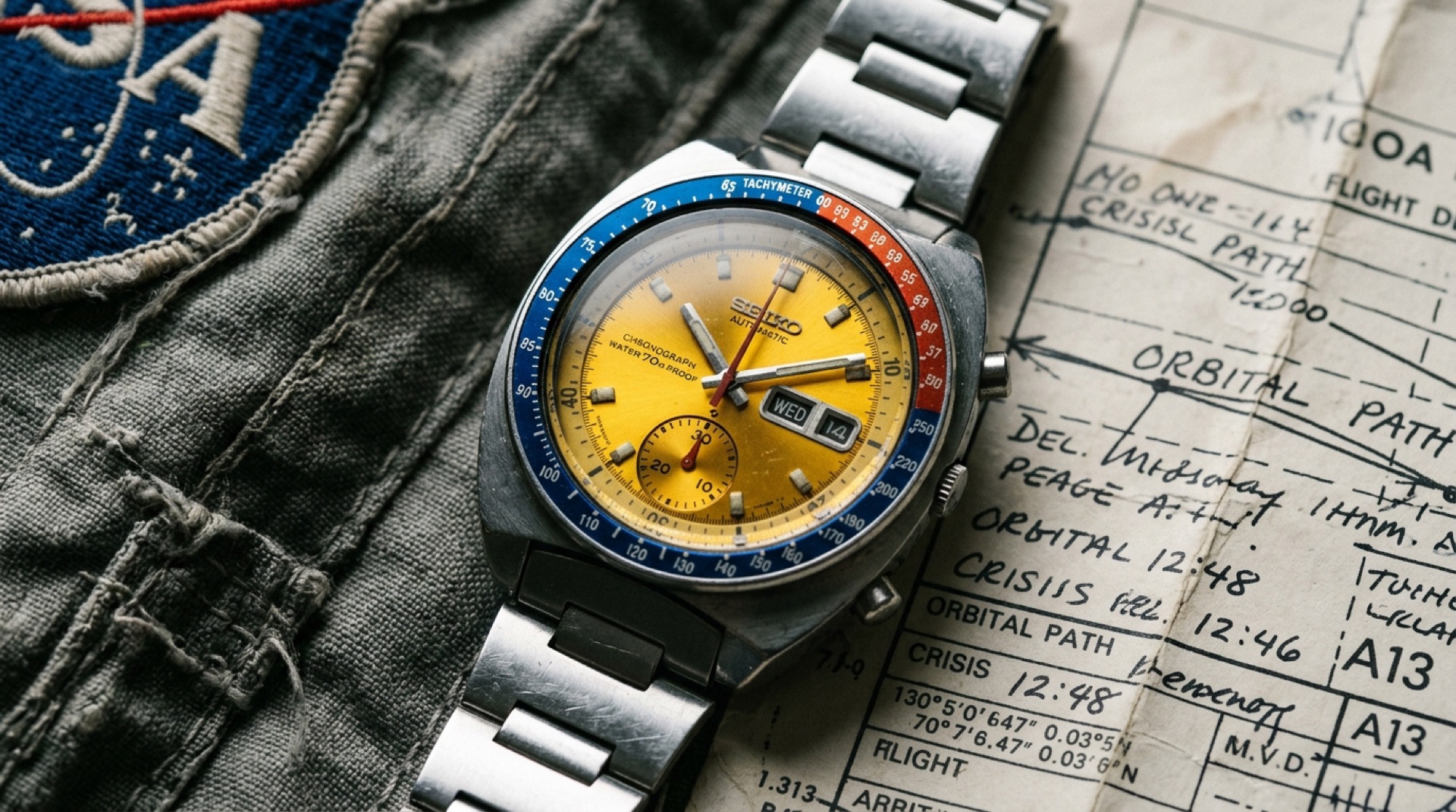
The story of watchmaking in the space race is often tied to the famous Omega Speedmaster. Yet in 1973, a Japanese watch quietly wrote a page of history aboard NASA’s Skylab 4 mission. That watch was the Seiko 6139-6002, affectionately nicknamed the Seiko Pogue.
The American colonel and astronaut William Pogue had bought the watch, with its bright sunburst yellow dial and its Pepsi bezel in blue and red, for 71 dollars at a military base, in order to time his ground training before departure. For the official mission, NASA had approved only the Speedmaster for extravehicular activity (EVA). But since his Omega had not arrived in time for training, Pogue decided to slip his Seiko 6139 discreetly into his personal kit.
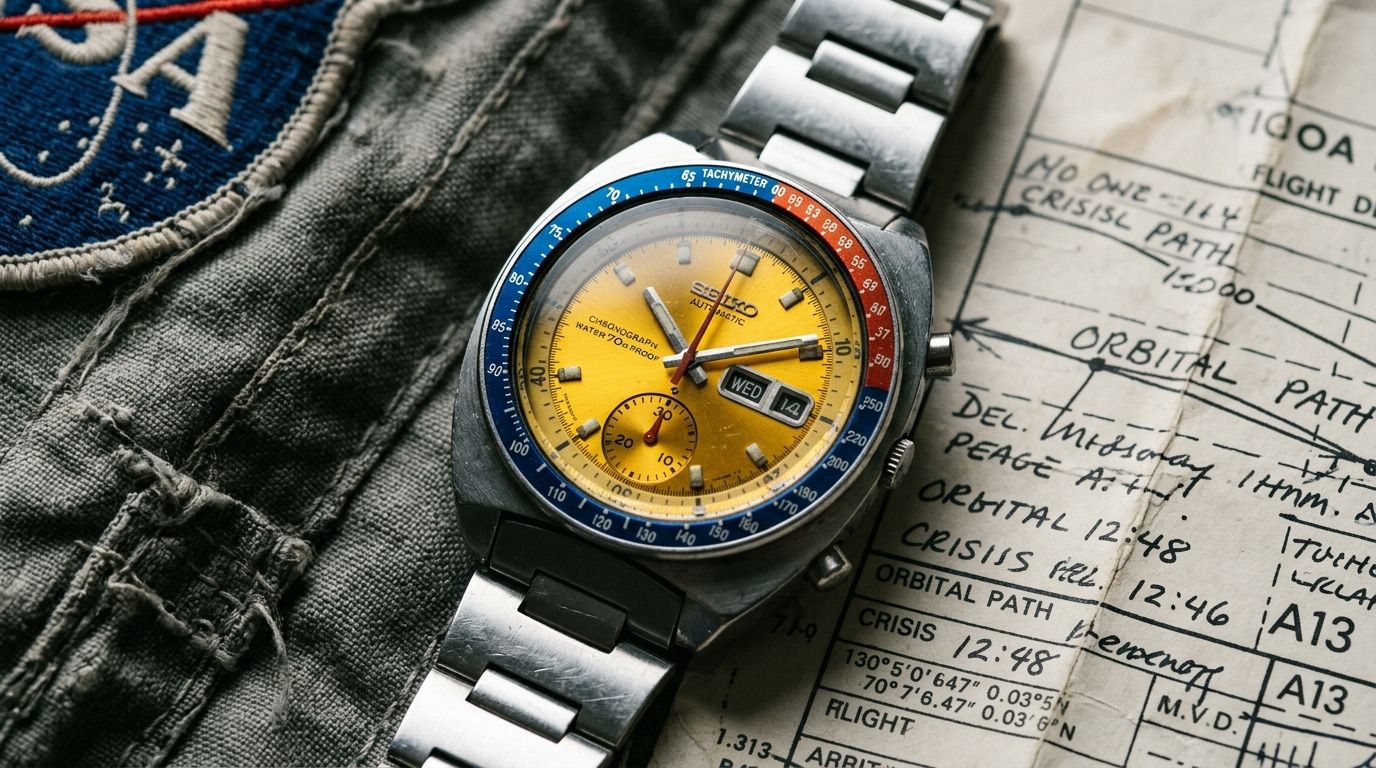
For 84 days in orbit around the Earth, Pogue used his Seiko to time the burns of the orbital station’s engines. And so, without NASA’s official blessing, the Seiko 6139 became the very first automatic chronograph to travel and to run in space.
From the deep cold of Antarctica to the vacuum of space, these timepieces do more than tell the time: they speak of an era when human adventure pushed at its limits, armed with unfailing mechanical precision.
Receive our watchmaking stories
Calibre guides, new arrivals and stories from Japan — plus 10% off your first watch.